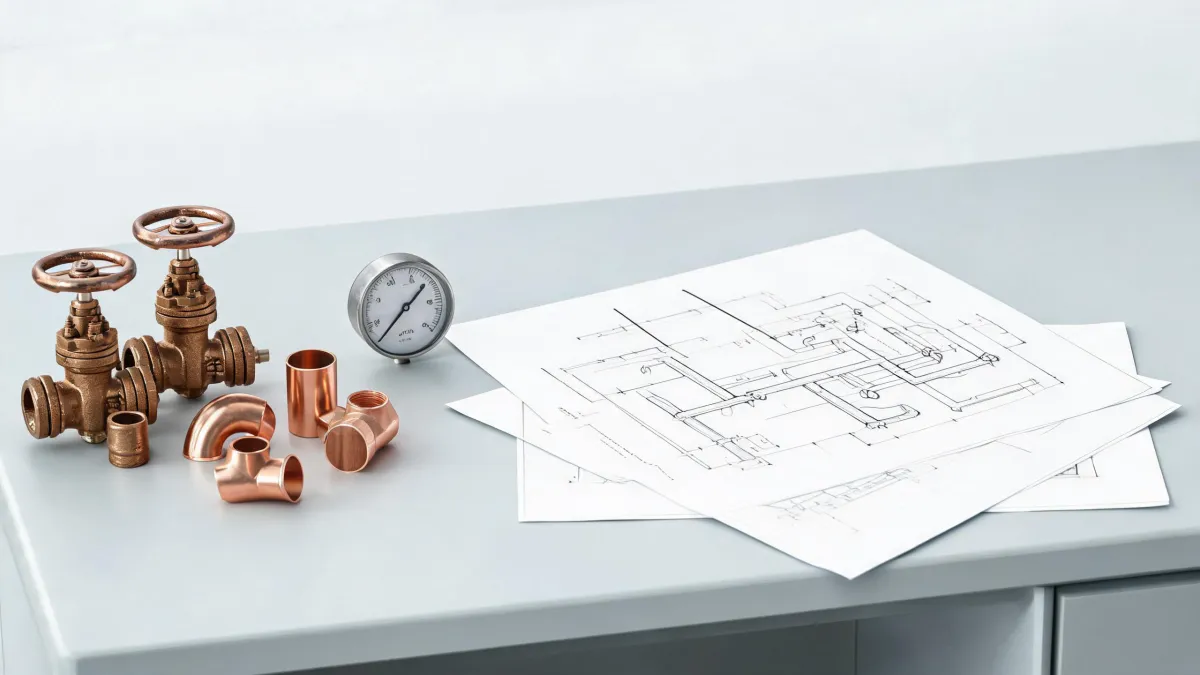
I'm the office administrator for a 180-person facilities company. I manage all the maintenance and repair supply ordering—roughly $180,000 per year across eight vendors. I'm not a plumber, and I won't pretend to be one. But I'm the person who reads the part numbers, calls the suppliers, and writes the purchase orders. When an order is wrong, it lands on my desk.
After five years of managing these relationships, I've learned one thing: the hardest part isn't price. It's turning a vague request into a correct order.
Here's the thing: a request for NIBCO ProPress copper fittings is not a part number. It's a category. But a lot of order requests look exactly like that—a category, not a specification.
I remember getting an email from a crew lead with a list that said:
- NIBCO ProPress copper fittings
- NIBCO true union ball valve
- ratchet repair kit 81339F
- steel framing hammer 22 oz
No sizes. No quantities. No tool model. Just a list of things someone knew by sight.
My first thought was: okay, I'll ask. But part of me thought this should be enough. It wasn't.
The Surface Problem: We Treat Ordering Like Data Entry
The surface problem looks like confusion about product numbers. It's easy to blame the person who wrote the request, or the supplier who couldn't fill it. But the real problem is deeper.
A product name is not a product decision. When someone writes NIBCO true union ball valve, they're describing a feature, not a specification. Which size? What end connections? Brass or stainless? Solder, threaded, or press ends? If I don't know those details, the supplier has to guess. When a supplier guesses, someone gets the wrong part and has to pay the return shipping.
Same thing with NIBCO ProPress copper fittings. They're press-connect fittings, which means they need the right press tool and the right jaw for the fitting size. The fitting can be perfect, the tool can be in great shape, and they still won't work together if the jaw doesn't match. That's not something I can see on a sticky note.
We didn't have a formal verification process. The third time we ordered the wrong NIBCO true union ball valve, I finally created a checklist. Should have done it after the first time.
The part number is a clue, not a specification. I honestly think that's the biggest misunderstanding I deal with.
NIBCO's catalog and technical data sheets are the closest thing I have to a translator. They list the exact figure number, the material, the end connections, and the pressure rating. I keep the pages for our most common orders in a binder next to my desk. When someone asks for a blue-handle valve, I pull the binder and read back what the catalog says. If the crew lead doesn't correct me, I order exactly that.
The Deeper Issue: Compatibility Is the Real Trap
The most expensive mistake I ever made involved compatibility, not price.
We needed a replacement part for a ratchet-style crimp tool. The request said ratchet repair kit 81339F. I looked it up, saw that it was a real part, and added it to the order. It wasn't until the tool specialist asked which tool it was for that I realized I was buying a repair kit for a tool that might not even be on our van.
That part number was one piece of the puzzle. The missing pieces were the tool brand, the model, and the serial number. Without them, the repair kit was a gamble.
The same pattern shows up with tools. Someone asked me: do you need impact sockets for impact wrench? It's a fair question, and the short answer is usually yes: regular chrome sockets can crack under the shock load from an impact wrench. But the more useful question is, which drive size? A 1/2-in impact wrench needs 1/2-in drive impact sockets. A 3/8-in tool needs 3/8-in drive. The right answer to the wrong question is still the wrong part.
This is where I have to be honest about my own limits. I'm not a tool engineer. I don't know the jaw profile for every press tool. What I can tell you from a purchasing perspective is that compatibility is something you verify, not assume.
The Cost of Guessing
The obvious cost of a wrong order is the part itself. The less obvious costs are the ones that show up on the job.
- Labor. A plumber waiting for the correct NIBCO ProPress copper fitting is billing hours while not working.
- Schedule. A repair that was supposed to take an hour becomes two trips to the supply house and a three-hour delay.
- Trust. When a field team says they need a NIBCO true union ball valve and the wrong one arrives, they don't blame the part. They blame the process.
- Restocking fees. Some suppliers charge a restocking fee for a factory order that was mis-specified. That's the tax on guessing.
One wrong valve did more damage than its price tag. The valve cost about $70, but the crew was on site, the line was open, and the part didn't fit. We paid for an overnight shipment, a return trip, and overtime. The real cost was closer to $600.
I thought about moving to a cheaper supplier once. The upside was maybe $2,000 a year in savings. The risk was losing a supplier who answered compatibility questions before I ordered. I kept asking myself: is $2,000 worth a delayed job and a frustrated crew? It wasn't.
What Actually Fixed It
What fixed it wasn't memorizing the catalog. It was changing how I start an order.
Three things matter for any NIBCO order: the exact product family, the size, and the end connections. In that order. And for tools, the same logic applies: exact model, drive size, and compatibility.
I now ask the same questions before I create a purchase order:
- What is this part replacing? Send a photo or bring in the old part.
- What end connections are on both sides? Press, threaded, solder, or PEX?
- If it's a repair kit, which tool does it fit? Get the model and serial number.
- If it's a valve, does it need to be serviceable without cutting the line? If yes, that's the case for a NIBCO true union ball valve.
- If it's a tool question, what is the drive size? For example, a 1/2-in impact wrench needs 1/2-in drive impact sockets.
I also read the order back to the supplier before I hit send. It feels old-school, but it catches mistakes that spell-check can't.
One more thing: I'd rather spend 10 minutes explaining options than deal with mismatched expectations later. Informed customers ask better questions and make faster decisions. That's true for NIBCO ProPress copper fittings, and it's true for a 22 oz steel framing hammer.
If you're reading this because you're the one who turns field requests into purchase orders, the answer isn't to know every product spec. It's to ask one more question before you click buy. That question usually saves the job.
I'm not a plumber, so I can't tell you which NIBCO valve to install in your system. What I can tell you from the purchasing side is that the part number is only one piece of information. The rest is context. Ask for the context before you order.