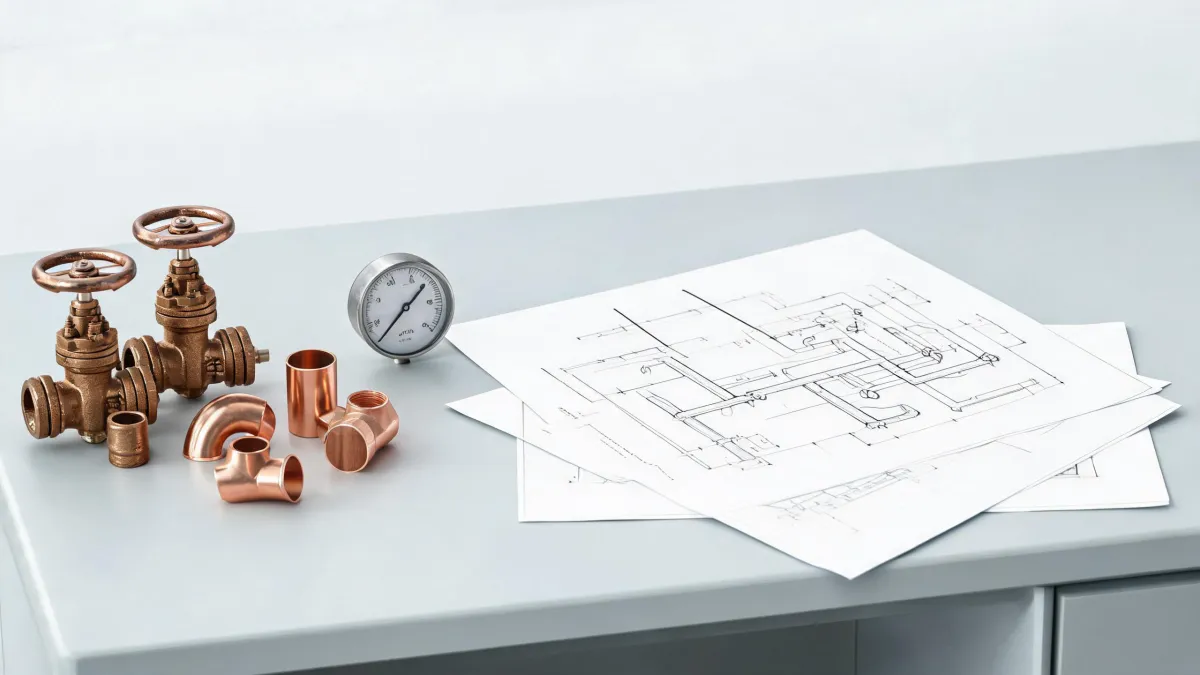
Let me tell you about the most expensive $45 part I've ever ordered.
Back in Q3 2024, a 1-inch drain valve on our main process line started leaking. Nothing dramatic — just a steady drip we figured we'd handle at the next maintenance window. Standard fix, standard part. I searched "nibco drain valve," found a NIBCO at a price that looked reasonable, and ordered it. Two days later, it arrived on the truck.
That valve ended up costing us $4,200 and change.
The Problem Nobody Starts With
If I asked you to guess where the money went, you'd probably say labor. And you'd be half right. Labor was a chunk of it. But the real culprit was a chain of small assumptions that stacked up into one very expensive mistake.
Here's the thing: the drain valve itself was fine. Solidly built, exactly what you'd expect from a reputable manufacturer. The problem was everything around it.
I'm a procurement manager at a 40-person manufacturing company. I've managed our maintenance budget ($120,000 annually) for six years, negotiated with more than 50 vendors, and documented every order in our cost tracking system. So when this "simple" repair went sideways, I had data to show exactly what happened. That didn't make it less painful to review, but at least it taught us something.
What Actually Went Wrong
Three things. All of them avoidable. And all three trace back to one root cause: I focused on the unit price and completely missed the installation context — connection type, bolt specifications, and the tools that would be used to install it.
1. We Bought the Part, Not the Connection
Our existing line used a flanged connection. The NIBCO drain valve I ordered was threaded — it was in stock, the price was right, and honestly, I wasn't thinking about end connections when I clicked "order." I was thinking about the part number. Classic rookie move.
So now we needed a threaded-to-flanged adapter. Not a huge deal, except the adapter had to be ordered separately, which meant a second shipping charge and a two-day wait. Then we realized the adapter pushed the valve body into a position where the handle couldn't fully open without clearing a support beam. That led to a third order: a different configuration. Three orders. Three shipping charges. Three days of waiting for a repair that should have taken 90 minutes.
2. We Ignored the Flange Bolt Spec
When the right valve finally arrived, my maintenance lead pulled up the flange alignment. The spec called for MET flange bolts — a specific bolt circle, thread pitch, and material grade. Not "whatever's in the hardware bin."
We had a box of flange bolts that were close. "Close" in flange bolt terms means the wrong thread engagement, which means a joint that isn't torqued right, which means a leak waiting to happen. The original bolts were corroded, and when we tried to reuse one, it snapped clean. So: another trip to the supplier, another delay. The replacement MET flange bolts cost $38. The labor to discover we needed them cost $500.
3. The Welding Detour
Somewhere in the middle of all this, the conversation shifted to welding. The crew was convinced the line needed to be patched or re-routed, and the question everyone was asking was how to set a welding machine for the job.
What we should have asked: does this modification need to be welded at all?
It didn't. A flanged butterfly valve — the kind NIBCO carries as a catalog standard — would have handled the flow control with zero welding. Instead, we spent two days prepping for a weld that never needed to happen. A certified welder, shielding gas, preheat, inspection sign-off: easily $1,500 that bought us nothing.
Here's the Math Nobody Wants to Do
I had to stare at these numbers in our cost system for a week. Here they are:
- Original drain valve: $45
- Wrong adapter fittings, plus shipping: $78
- Correct valve with expedited freight: $214
- MET flange bolts (after the old one snapped): $38
- Labor, including the redo: $1,150
- Emergency supply runs: $180
- System drain and refill: $620
That's $2,325 in direct costs. Add roughly $1,900 in lost production while the line sat idle, and the total is $4,225. That's how a $45 part becomes a four-figure expense. (And that total doesn't include the frustration, which is free.)
The Cost of Getting It Wrong, Repeatedly
Over the past six years of tracking every invoice, I've watched this pattern repeat more times than I can count. When I audited our 2023 spending, I found that 23% of our maintenance budget went to rework and emergency repairs caused by parts purchased on unit price alone. Analyzing $180,000 in cumulative spending across six years, about $28,000 went to things we essentially bought twice — once as the "cheap" option, and once as the correct one.
If you're a small operation or a solo contractor, this hurts even more. You don't have a budget buffer. A mistake like the one I just described can eat a week of profit. That's why, as a small customer, I've made it a rule to work with vendors who take small orders seriously. The distributors who treated my $200 orders with respect when I was starting out are the ones I still use for $20,000 orders. Small doesn't mean unimportant — it means potential.
What We Do Differently Now
I won't pretend we've eliminated every mistake. But we've cut maintenance rework by roughly a third since we changed our process. Four things made the difference:
1. Buy the Complete Assembly
When we order a valve, we spec the whole assembly: valve, flange bolts, gaskets, and any adapters. A full-line supplier makes this easier — you can match a valve to fittings and repair kits without juggling incompatible product lines. It costs a little more up front and saves a ton of time and freight on the back end.
2. Ask "Do We Need to Weld?" Before Firing Up the Machine
Now, any time someone starts thinking about how to set a welding machine, we stop. Is welding the simplest joining method here, or would a flanged, threaded, or press connection solve it with less risk? Welding absolutely has its place. It should be a choice, not a default. In our case, a butterfly valve with a gear operator eliminated welding entirely — no inspection delays, no weld defects, no weekend work.
3. Tool Up Before You Need the Tools
Our technicians now have a proper plier wrench set on hand — the multi-size kind that grips without marring — for clean work on valve bonnets and fittings. It sounds small, but using the wrong wrench damaged a valve body in the past. (We learned that one the hard way, unfortunately.)
4. Keep Critical Spares
We stock a small inventory of the valve types we use most — drain valves, butterfly valves, and the MET flange bolts that go with them. Now when something fails, we're not making an emotional decision at 4:00 PM on a Friday. We make the right decision when we're not under pressure.
Pricing note: Estimates above are based on a 1-inch lead-free bronze drain valve (typically $25–$75 depending on configuration) and a 4-inch lug-style butterfly valve with gear operator (roughly $350–$900 depending on disc material and seat). Figures are from publicly listed distributor pricing as of January 2025. Verify current rates with your supplier — prices move.
Bottom Line
The problem was never the $45 valve. The problem was that I treated a maintenance repair like a commodity purchase instead of an engineering decision.
There's something genuinely satisfying about walking into our maintenance cabinet now and seeing the right drain valve, the right MET flange bolts, and the right gaskets sitting together in a labeled bin. That's the feeling of a budget under control. The repair that once took a week now takes 45 minutes.
If you're about to order a replacement valve, take ten extra minutes to check the end connections, the flange bolt spec, and the tools your technician will actually use. That's the cheapest insurance you can buy. Trust me on this one — I've got six years of invoices that prove it.