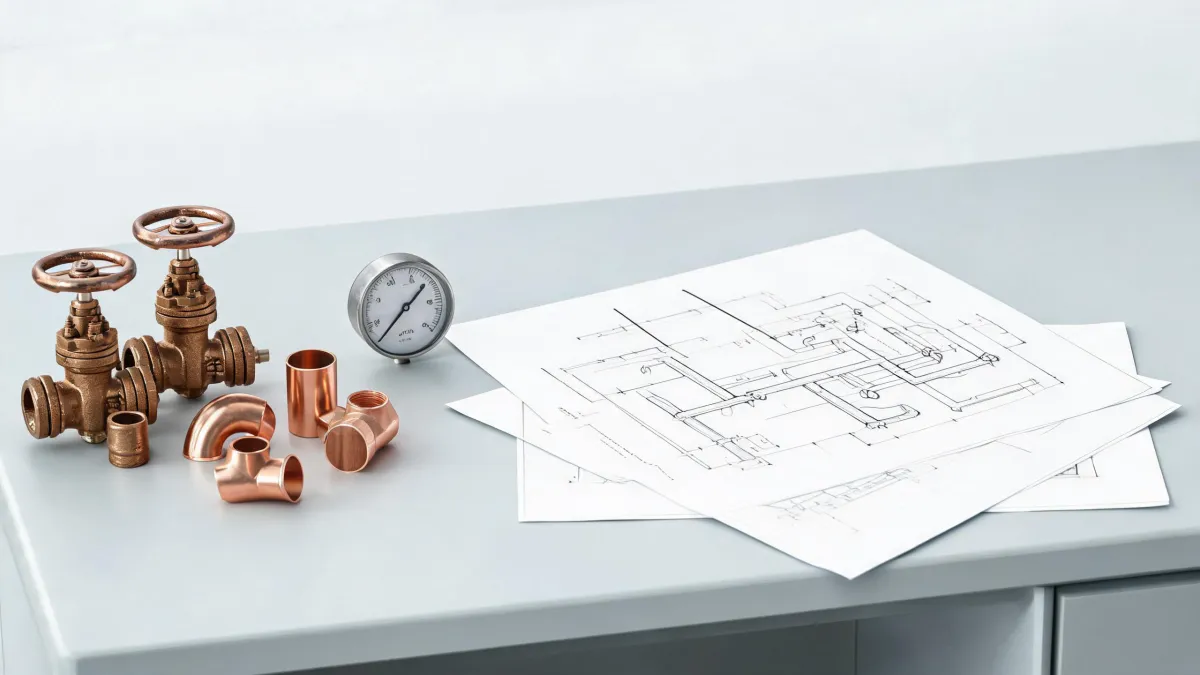
I review hardware for a living. Six years in quality and brand compliance for an industrial supply company. Roughly 200 line items a month—valves, fittings, compressor parts, hanging hooks, cabinet hardware, the whole spread. In Q1 2024, I rejected 14% of first deliveries. Not defective products. Wrong products for the job.
That's the part most buying guides skip. There's no universal "best" when it comes to hardware. The right valve for a steam line is wrong for potable water. The hooks that hold 50 pounds on a stud wall won't hold 50 pounds on old plaster. I've watched purchasing managers burn budget because they treated every order the same way.
So here's how I'd break it down. Three scenarios. Find the one that matches your situation. Because the answer changes depending on what you're actually doing.
Scenario A: New Construction or System Retrofit — Piping and Valves
If you're specifying valves and fittings for a commercial or industrial piping system, your first move isn't comparing prices. It's pulling the catalog.
I keep a NIBCO gate valve catalog on my desk. Not out of brand loyalty—because the spec sheets are complete. Pressure ratings, temperature limits, materials, end connections, flow coefficients. Everything I need to verify before I approve anything. When I train new buyers, I tell them the same thing: if you can't find the spec you need in the catalog, that's a red flag. Either the manufacturer doesn't publish it, or you're looking at the wrong product.
Here's where I see people go wrong. They pick a valve based on size and pressure rating, then assume everything else is fine. But what's the media? Steam, water, gas, chemicals? Each one changes the material requirements. What's the ambient temperature? What's the cycle frequency?
Small detail. Big consequences.
We had a contractor specify standard bronze gate valves for a system that ran slightly above the rated temperature. Not by much—maybe 15 degrees. Over six months, those valves started weeping at the stem. Replacement cost was about $10,000 total—parts and labor. Actually, closer to $10,200 when I added up the overtime hours. Either way, a five-minute spec check would have prevented it.
This is also where lead-free requirements come in. If your system touches potable water, verify compliance. Don't assume. I've seen buyers get burned because they thought "bronze" meant "lead-free." It doesn't. Check the certification. Every time.
What I look for in this scenario:
- Complete spec sheet from the manufacturer—not a distributor summary
- Material certification for the specific media
- Lead-free compliance documentation if applicable
- Consistent sizing across the product line to prevent field modifications
One more thing. Don't overlook the repair and maintenance side. If you're specifying NIBCO valves, make sure the repair kits are available and documented. I've seen projects where the valves were fine but the NIBCO 80 repair kit wasn't stocked anywhere locally. A $40 part turned into a week-long delay because nobody checked availability before installation.
Standard replacement gate valves for commercial applications typically run $60–180 depending on size and material (based on distributor quotes, early 2025; verify current pricing). But the part cost is rarely the real expense—it's the labor and downtime when something goes wrong.
Which brings me to the next scenario.
Scenario B: Maintenance and Repair — Compressor Parts and Tools
This is a different beast. When you're buying tools parts air compressor components for maintenance, you're usually under time pressure. Something broke. Production is down. You need the part now.
I get it. I've been there. Two years ago, our main shop compressor went down on a Friday afternoon. I had maybe three hours to source a replacement valve and gasket kit before the weekend shutdown. Normally I'd compare three vendors and verify specs. But with the clock ticking, I went with our usual supplier based on trust alone.
It worked out. But I got lucky.
In hindsight, I should have pushed for at least a spec confirmation over email. But with the production manager standing in my office, I made the call with what I had.
Here's what I've learned about maintenance parts: the brand matters less than the fit and the availability. A no-name compressor valve that fits perfectly and ships overnight beats a premium brand that takes two weeks. The math is simple—downtime costs more than the part.
My checklist for maintenance buys:
- Does it fit the exact model number? Not "similar to." Exact match.
- Is the seller reputable enough that returns won't be a nightmare?
- What's the realistic lead time? Verify. Don't trust the website.
- Is there a repair kit or rebuild option? Sometimes that's faster than a full replacement.
One thing I'll say about air compressor parts specifically: don't cheap out on filters and gaskets. The cost difference between a quality gasket and a bargain one is maybe $5. The cost of a failed gasket—blown seals, contaminated oil, downtime—is hundreds. That's a no-brainer.
Scenario C: Home or Light Commercial Installation — Hooks and Cabinet Hardware
Okay, this one's different. When you're buying hanging hooks or cabinet hardware, you're probably not dealing with industrial specs. But that doesn't mean you should just grab whatever's on sale.
Let's talk about the 50lb white classic hanging hooks. These are everywhere—big box stores, online, hardware shops. They all say "50lb capacity." But here's the thing: that rating assumes ideal conditions. Perfectly installed into solid wood studs or properly anchored drywall. If you're hanging something on plaster, or old drywall, or worse—just drywall with no anchor—that 50lb rating is basically meaningless.
I've seen inventory managers order these hooks in bulk for facility maintenance and then get complaints because they pulled out of walls. Not defective hooks. Nobody told the installers to check the wall material first.
Small doesn't mean unimportant—it means potential. The same goes for small orders. A maintenance tech ordering 20 hooks for a facility job deserves the same spec guidance as a contractor ordering 2,000 valves. The order size doesn't change the stakes.
Now, cabinet hardware. "What are the best cabinet hardware brands?" Honestly? Depends on what you're doing. For kitchen remodels, you want brands that offer consistent finishes across a full line—because a brushed nickel pull from Brand A won't match a brushed nickel pull from Brand B. For commercial cabinetry, durability and warranty matter more than aesthetics.
What I look for:
- Finish consistency across the product line—order samples first
- Replaceable components—can you swap just the pull, or do you replace the whole hinge?
- Clear installation specs—template requirements, screw sizes
And here's a reverse validation moment for you. I used to think "premium" cabinet hardware was a waste of money. Then I watched a client save $400 on knockoff hinges for a 40-door commercial project. Eighteen months later, half of them were sagging. The cost to replace them—parts and labor—was about $2,800. Everyone told me to always check the hinge cycle rating before approving. I only believed it after skipping that step once and eating an $800 mistake on a smaller job.
For reference, decent cabinet hinges for light commercial use run $2–8 per piece depending on material and cycle rating (based on major hardware retailer pricing, early 2025; verify current rates). The cheap ones are $1–2. That gap matters when you're buying 40 or 400.
How to Figure Out Which Scenario You're In
Here's a simple test. Three questions:
- What happens if this part fails? If the answer involves safety, downtime, or water damage, you're in Scenario A or B. If it's a crooked cabinet door or a picture falling, Scenario C.
- Who's installing it? A licensed contractor or maintenance tech will read the specs. A homeowner might not. Buy accordingly.
- What's your lead time tolerance? If you can wait two weeks and compare options, do that. If you need it tomorrow, prioritize availability over optimization.
Most buyers I know operate in all three scenarios depending on the day. The trick is recognizing which one you're in before you place the order—not after the shipment arrives and something's wrong.
The best part of getting this right: no more emergency calls about failed parts. No more "why doesn't this fit" emails. Just the quiet satisfaction of a job done correctly the first time. That's the payoff.
And honestly? That's worth more than whatever you save by cutting corners.
Pricing references are for general guidance only. Actual prices vary by vendor, quantity, specifications, and time of order. Verify current rates with your supplier.