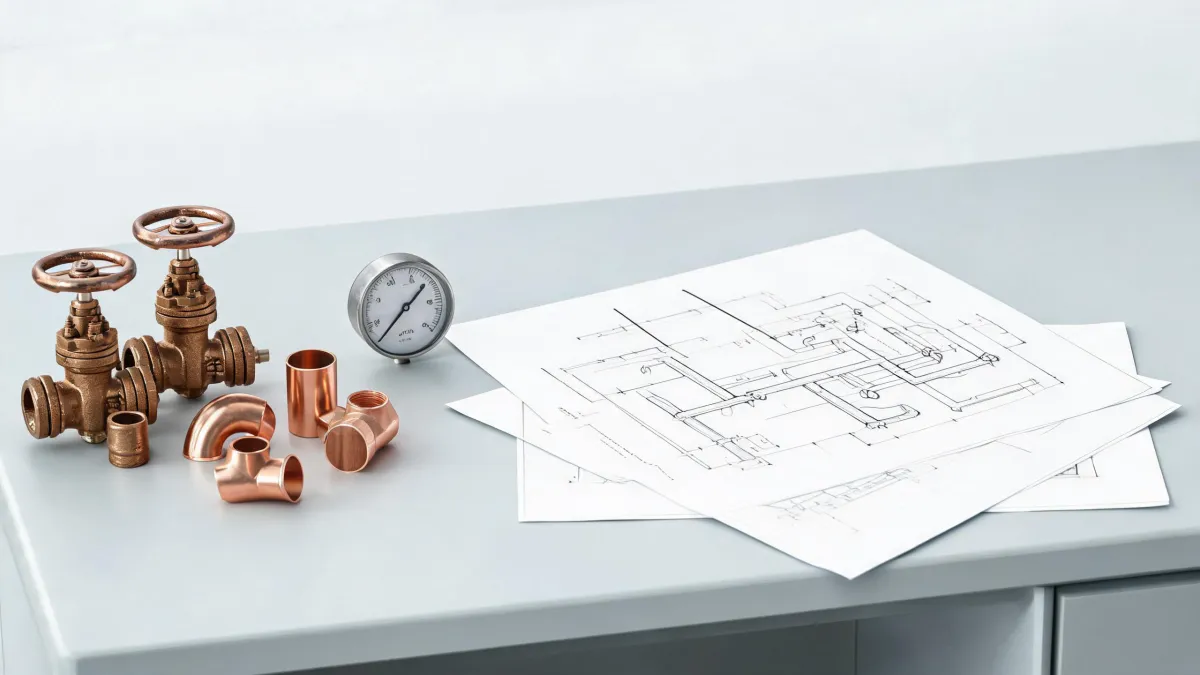
Why I Started Comparing Brand vs. Generic Parts
I'm the office administrator for a 140-person company across two buildings. I manage all facilities-related ordering—roughly $180,000 annually across 12 vendors. That includes everything from NIBCO copper fittings for our maintenance crew to replacement blades for the ratchet loppers our grounds team uses.
After five years of managing these orders, I've developed a fairly strong opinion on brand-name versus generic parts. But it's not a simple answer. Some things are worth the premium. Others, I've regretted every dollar I spent on the brand version.
So here's how I actually evaluate these decisions now. Three dimensions: compatibility, total cost of ownership, and what happens when it fails.
Compatibility: Where Brand Names Usually Win
This is the dimension where generics get me in trouble most often. Especially with NIBCO copper fittings and valve components.
When our maintenance lead orders NIBCO copper fittings, they fit. The tolerance on the press connections is consistent. When we tried to save money on a generic brand of press fittings back in 2023, three out of fifteen leaked during the pressure test. Not because the crew did anything wrong—the fitting dimensions were just slightly off spec.
That wasn't a savings. That was a callback.
Same story with valve handle extensions. We use them on older valves where the handle's too short to reach past insulation. The NIBCO extensions snap on cleanly. The generic ones we tried had a slightly different spline count. We didn't notice until the crew was already on a ladder.
Here's the thing: with mechanical parts, "close enough" isn't a spec. It's a liability.
So on compatibility alone—brand wins, and it's not close. At least, that's been my experience with pressurized systems and anything that carries water.
Total Cost of Ownership: Where the Math Gets Interesting
But compatibility isn't the whole picture. I also track what these parts cost us over time, not just at the register.
Take ball valves. We spec'd a specific MAX ball valve (I think the part number was UR22222, though I'd have to check the last PO) for our chilled water loop. The generic equivalent was about 40% cheaper per unit. But we replaced four of them in eighteen months. The MAX valves—we haven't touched the ones we installed in 2022.
If I remember correctly, the generic valves were around $28 each versus roughly $47 for the brand. Four replacements later, we'd spent $112 on generics to avoid spending an extra $19 per valve upfront. That's not savings. That's a payment plan for regret.
But here's where the math flips: tool replacement parts.
Our grounds crew uses ratchet loppers. The OEM replacement blade costs about $22. A generic three-pack on Amazon runs $15. We've been using the generics for two seasons now. Cutting performance? Honestly, I can't tell the difference. Longevity might be slightly worse—the generics seem to dull about 20% faster—but at that price spread, it doesn't matter.
Moral of this dimension: if the part is inside a pressurized system, brand wins. If it's a blade that touches hedges, generic is fine.
Failure Consequences: The Hidden Deciding Factor
This is the dimension most people don't think about until it bites them.
What happens when this part fails? If the answer is "we replace it and move on," generic is usually fine. If the answer is "water damage, downtime, and a call from my VP," brand is cheaper than the alternative.
This is also why I pay attention to tool categories. When we were looking at angle grinders for the maintenance shop, I had to learn what a brushless angle grinder actually was—I'd been buying whatever was on sale. Turns out, brushless motors last significantly longer and run cooler. They cost more upfront, but the failure consequence (a crew member stuck without a working grinder mid-project) made the premium worth it. We switched to brushless and haven't looked back.
I've never fully understood why brushless motors command such a premium on paper—the components aren't that exotic. My best guess is it's a combination of R&D recovery and the fact that buyers like me will pay it to avoid the downtime.
Either way, the consequence framework makes the decision easier.
How I Decide Now
Three questions, in order:
- Does it carry pressure, water, or gas? Brand name. NIBCO copper fittings, valve components, ball valves—no exceptions.
- Will failure cause downtime or damage? Brand name. Brushless tools over cheap brushed ones. Quality accessories over bargain-bin versions.
- Is it a wear item with no downstream consequence? Generic is fine. Ratchet lopper replacement blades, consumables, shop rags.
This worked for us, but we're a mid-size operation with a maintenance crew that's stretched thin. If you're a larger facility with dedicated staff who can afford callbacks, your calculus might be different.
And obviously, none of this applies to Class 1 hazardous environments or medical gas systems—that's a completely different regulatory world I only touch at the edges.
Point is: brand versus generic isn't a philosophy question. It's a consequence question. Answer that, and the choice usually makes itself.
— Prices referenced are based on our 2024–2025 purchase records. Verify current pricing with your vendors; it moves.