-
Before you order parts: which pressure-washer inlet do you actually have?
-
1. If the pressure washer stays portable, do not run a copper branch line
-
2. If the washer stays in one bay: the NIBCO T-113 gate valve starts to earn its place
-
3. If you are feeding multiple pressure washer stations: use the NIBCO copper pipe fitting takeoff chart
-
How to turn off a gate valve without breaking it
-
Tools I keep nearby
-
Which setup is worth the money for you?
Before you order parts: which pressure-washer inlet do you actually have?
I handle procurement for a 14-person maintenance company. For the last six years, every valve, copper stub, repair kit, and pressure washer attachment I have ordered has gone through a cost-tracking sheet. The running total sits around $160,000. The most expensive pattern I see is not the purchase price. It is the bargain that does not match the actual job.
When someone asks me how to turn off gate valve issues or what valve to put on a new pressure-washer connection, my first answer is usually the same: it depends on whether the washer is portable, fixed in one bay, or feeding multiple cleaning stations.
Here are the three situations I see most often, and the advice I would give for each.
1. If the pressure washer stays portable, do not run a copper branch line
The temptation is to build something permanent because it looks more professional. But a portable pressure washer that gets stored on a shelf or rolled around a shop does not need its own hard-piped supply. It needs a reliable hose connection and a few pressure washer attachments that are easy to swap.
Keep the supply side simple: a hose bib, a vacuum breaker, a good inlet hose, and a strainer or quick-connect at the machine inlet. The pressure washer itself already has an inlet fitting designed for a flexible garden-type hose. Hard-piping into that inlet is a mistake. The machine vibrates, hoses flex, and the plumbing needs movement allowance.
Not every project needs a NIBCO T-113 gate valve. If the washer is used from different locations, install a backflow-safe yard hydrant or hose outlet, but skip the expensive copper work.
2. If the washer stays in one bay: the NIBCO T-113 gate valve starts to earn its place
A permanently mounted pressure washer in a wash rack or maintenance bay is a different story. I usually recommend running a dedicated 3/4-inch copper supply branch with a shutoff valve before the flexible hose that feeds the machine.
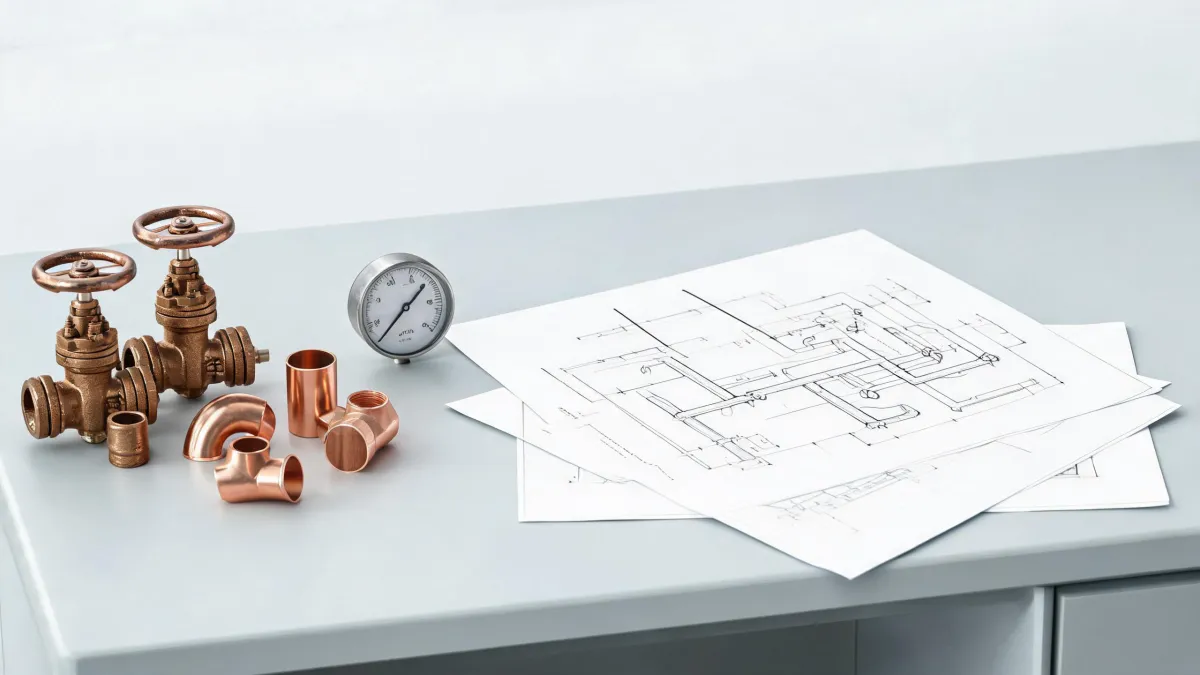
The NIBCO T-113 gate valve belongs in that supply line. It is a threaded bronze gate valve that has been on maintenance stock lists for a long time, which is exactly why I standardize on it. It has known dimensions, known thread types, and published catalogs. That matters more than a low number on an invoice.
One caution: a T-113 gate valve is an isolation valve, not a precision flow-control valve. Use it fully open or fully closed. If you need to regulate water flow to a pressure washer, adjust the unloader or use a separate ball valve. A gate valve partly open is asking for wire-drawn seats and a valve that will not close tightly later.
For a fixed bay, the usual arrangement is:
- A 3/4-inch copper takeoff from the water source.
- A NIBCO T-113 gate valve for shutoff.
- A backflow preventer or vacuum breaker at the hose connection before the pressure-washer inlet hose.
- A short flexible inlet hose to the machine so vibration does not crack rigid pipe.
Do not skip the backflow piece. If the pressure washer has a detergent injector, the supply side needs protection. That is a code issue, not an optional upgrade.
3. If you are feeding multiple pressure washer stations: use the NIBCO copper pipe fitting takeoff chart
This is the point where most cost surprises start. One fixed pressure washer can run on a simple branch. Two or three stations fed from the same supply line need proper sizing and proper measurements. Two 3,500-psi machines can pull more water than a 1/2-inch copper stub can deliver. I usually go up to 3/4-inch or 1-inch for a manifold feeding multiple wash bays.
When the installation has tees, elbows, and adapters, guessing the pipe length is expensive. Copper is not cheap, and scrap ends from a bad measurement still cost money. The free way to avoid that is to consult the NIBCO copper pipe fitting takeoff chart before ordering or cutting.
Here is how I use it: I sketch the line, mark the center-to-center distance between fittings, subtract the takeoff for each fitting, and then add the insertion depth for press ends. That gives the actual pipe length. It sounds tedious, but it takes about ten minutes and saves an extra trip to the supply house.
What I mean by takeoff is not a vague guess. It is the published fitting dimension that tells you how much space the fitting consumes. If you ignore it, the total assembled length ends up wrong. The result is a cut pipe that is too short, which is exactly the kind of hidden cost that never shows up on the original quote.
If the T-113 is threaded and the rest of the line is copper pressure pipe, count the adapter as part of that calculation. A press-to-thread adapter has its own takeoff dimension. The T-113 itself may be female NPT, so make sure the adapter matches the valve and the tubing size.
How to turn off a gate valve without breaking it
Gate valves have a bad reputation because people crank them too hard. A NIBCO T-113 gate valve closes by turning the handwheel clockwise. That sounds obvious, but a lot of field damage happens at the final half-turn.
Close the valve slowly, especially if the system has been off for a while. Water hammer is real. Turn the handwheel clockwise by hand until you feel the wedge seat. Then stop. A gate valve does not need to be brutally tight. If it still leaks through when closed, the problem is usually a worn seat, damaged wedge, or debris holding the gate open. Tightening it harder will not fix that. It will only twist the stem or crack the handle.
To open it again, turn the handwheel counterclockwise. If the valve has a rising stem, the stem position tells you whether it is open or closed. If it is a non-rising stem design, count the turns during installation or mark the handle position. That prevents you from guessing later.
A low-quality valve fails at exactly this point. The first time a mechanic tries to close an inexpensive valve after six months of no use, the handle spins, the stem strips, or the wedge drops loose. That is not a repair conversation. That is a replacement conversation during a time-sensitive job.
Tools I keep nearby
For the brass fittings around a pressure-washer inlet, I prefer an adjustable pliers wrench over a standard pipe wrench. A pipe wrench can chew up the flats on brass adapters, especially when someone is in a hurry. An adjustable pliers wrench grips wide flats without digging into the metal, and it is easier to use in a tight wash-bay cabinet.
I keep one in the maintenance cart along with spare hose washers, a thread sealant rated for the service, and a labeled extra T-113 if the site has multiple bays. The wrench is not the star of the show, but it prevents the expensive adapter from becoming scrap.
Which setup is worth the money for you?
Here is the decision guide I use when we bid a pressure-washer outlet:
- If the washer is moved around or used outdoors from different faucets, use a portable hose setup. Do not pay for a T-113 and copper branch that will sit unused.
- If the washer is fixed in one bay and gets used at least weekly, install a dedicated 3/4-inch branch with a NIBCO T-113 gate valve and a proper backflow connection.
- If the site has multiple wash stations or multiple pressure washer hookups, build a copper manifold, check the flow capacity, and use the NIBCO copper pipe fitting takeoff chart before cutting anything.
The lowest quote is not the cheapest option. I have seen that mistake enough times to stop believing in sticker price. A valve that fails after sitting closed for six months costs more in labor, downtime, and fittings than the few dollars saved on the original purchase. For our budget, the best price is the one that works the first time and does not need a second visit.