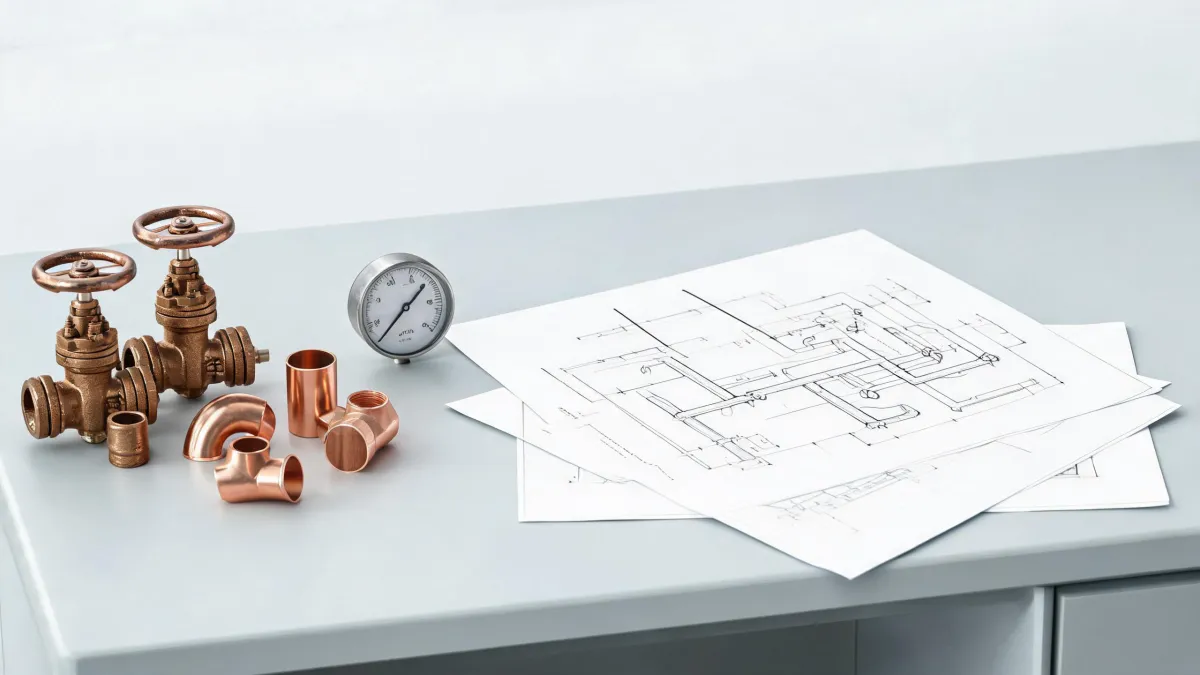
I keep a pair of 20 inch pliers in the truck. Not because they are the right tool for NIBCO parts. Because one winter I needed them to break loose an old double check valve, and that mistake taught me more than any product catalog did.
For the past eight years, I have ordered NIBCO valves, copper fittings, and repair kits for a commercial mechanical contractor. I have personally made and documented 14 significant mistakes, totaling roughly $3,800 in wasted budget. Now I maintain our team's checklist. This is the short version of what I learned.
All of the NIBCO-specific references here are from the published NIBCO product data sheets I keep in the shop, current as of March 2025. Product lines change, so verify part numbers before you order.
The comparison that matters is not NIBCO versus another manufacturer. It is look-it-up versus I-think-I-know-it. After a lot of painful invoices, I put the NIBCO ball valve catalog and the NIBCO copper fittings spec sheet at the center of our ordering process.
Here is how I would compare those two habits: cost, connection details, and the limits of the documents. Hopefully one of these keeps you from making the same mistakes.
Cost: what the catalog actually prevents
In 2017, I ordered 60 NIBCO copper adapters for a plumbing rough-in. I was in a hurry, the supplier said they had stock, and I checked the price but not the end connections. They showed up as C x C. The fittings I needed were C x M. Same brand. Same basic shape. Completely different part.
The vendor took them back with a 20% restocking fee plus freight. $380 gone, plus 4 days of schedule slip. The NIBCO copper fittings spec sheet had the dimensions and end connection codes on one page. I did not open it.
I used to think that two-minute lookup was not worth the wait when the supplier was on the phone. The upside was saving two minutes. The risk was repeating a $380 mistake. Eventually the math got obvious.
Here is something you only learn after a few returns: the NIBCO ball valve catalog matters even more because ball valves have more variables. Solder, threaded, press, flanged, two-piece, three-piece, full port, standard port. The catalog separates them by series. When I take 30 seconds to look up a part number, the valve shows up as the valve I meant to order.
Connections: catalog versus field conditions
I used to think a double check valve was a double check valve. That is not true. A double check valve can have threaded ends, solder ends, flanged ends, or press ends. It can be 3/4 inch or 6 inch. If I order from memory, I am betting on my memory. And my memory has lost that bet.
In September 2022, I had a replacement project with a tight window. I grabbed a 20 inch pliers because I could not get a coupling nut to move. It slipped, I damaged a copper stub-out, and the repair turned into a $320 rework. The question I should have asked was not 'how hard can I pull?' It was the same question I had ignored before: what size are hose clamp nuts on this clamp?
The answer, for most standard worm-drive clamps in the 1/2 to 1 inch range, is 7mm or 8mm. Not 'grab the biggest thing in the truck.' A 7mm socket would have been faster and cheaper.
For a NIBCO repair kit, though, do not trust my rule of thumb. Check the kit's parts sheet. The clamp style can be different on a double check valve repair kit, and the nut size can be different from the clamp on a garden hose.
Why the NIBCO copper fittings spec sheet is the boring one
The NIBCO copper fittings spec sheet does not have great photos. It has long columns of nominal sizes, outside diameters, and dimensions. That is exactly why I like it. It turns 'I think this will fit' into 'this is the dimension that will fit.'
When I restocked our van in Q3 2024, I checked every copper fitting against the spec sheet. We caught 47 potential errors in 18 months using the same checklist. Most were not dramatic. One wrong end connection, one wrong size, one type of tee that looked right but was not.
The same logic applies to the NIBCO ball valve catalog. It gives dimensions, body material, port style, and pressure series. It also keeps you from buying a valve that is close but not correct. Close only counts in horseshoes, not on a 2-inch hot water line.
The limit nobody tells you about
Here is the part I did not expect: neither document is a complete installation manual. The NIBCO ball valve catalog can tell you the valve dimensions, but it will not tell you whether the valve will fit in the tight spot behind an existing double check valve. The copper fittings spec sheet will not tell you the local code requirement for support spacing. That is not a flaw. It is a boundary.
I recommend using these documents as a pre-order checklist, not as a substitute for measuring the actual installation. If you have a replacement project, read the nameplate on the old part and measure the piping before you order. If you are working with a double check valve, the model and size printed on the body are worth more than my memory.
This approach worked for us because our shop mostly does commercial maintenance work. If you are a residential service tech doing one-off repairs, the catalog is still useful, but the old part on the wall often tells you more.
My recommendation after eight years
Use the NIBCO ball valve catalog when you are choosing a valve family or a part number. Use the NIBCO copper fittings spec sheet before you approve any copper fitting, especially if it has more than one end connection. If you are dealing with a repair kit, use the kit's parts diagram, not the catalog photo.
If your question is 'what size are hose clamp nuts?' start with 7mm and 8mm sockets, but look at the clamp itself. Some clamps have a slotted hex head that a socket can grab. Some do not. And a 20 inch pliers should be the backup tool, not the first tool.
I still keep the 20 inch pliers in the truck. But now it is for things that actually need leverage, not for fixing a mistake I caused by skipping a five-minute check.
No document is perfect. The catalog and the spec sheet are not replacements for field experience. They are the reference points that make field experience worth something. If you are in the middle of an order right now, take the extra two minutes. It is way cheaper than the other option.
Prices and schedule impacts in this piece come from my own invoices and project notes. Prices as of 2024; verify current pricing and availability with your supplier.