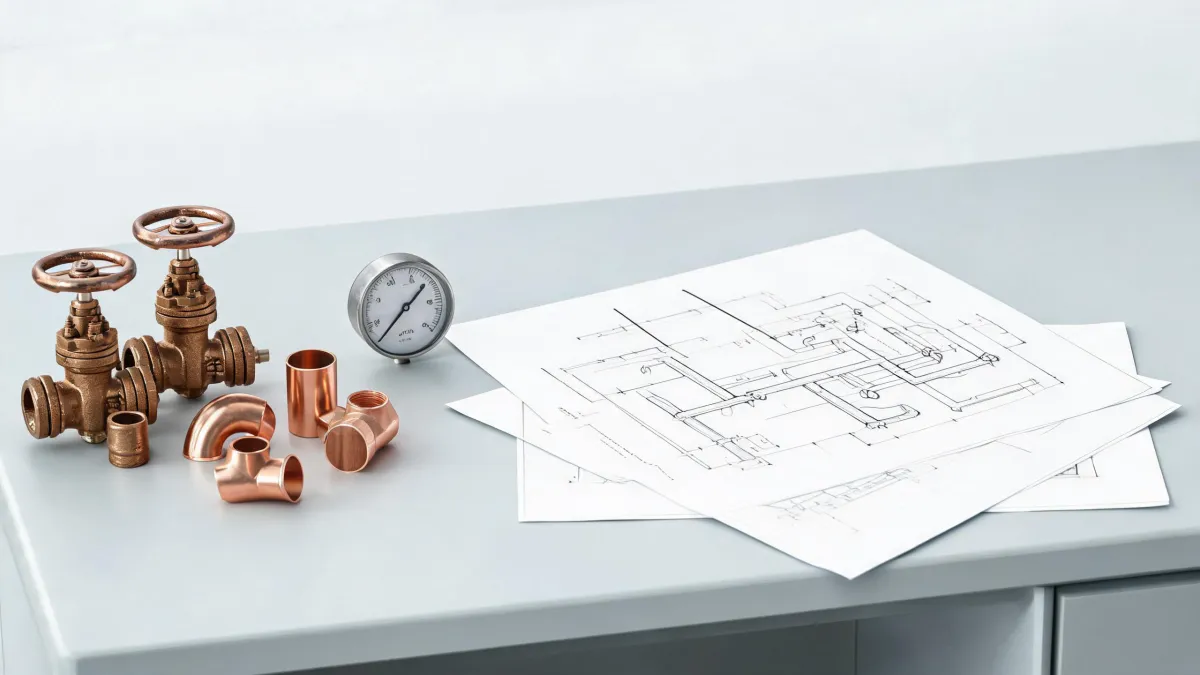
Let me start with the sentence I keep repeating to estimators and installers: most valve problems are spec problems, not product problems. The valve is not the weak link. The weak link is assuming that any part with the right thread size will do.
My job is quality and brand compliance for a B2B plumbing and HVAC supply company. I review every new SKU before it reaches customers - roughly 200 items a year. Maybe 180, I'd have to check the audit log. In our Q1 2024 quality audit, I rejected about 12% of first-round spec submittals because the documented dimensions didn't match the physical product. That isn't an unusual rate. It's a reminder that the phrase it looks right has no place on a material submittal.
After four years of reviewing returns, I've landed on an opinion that doesn't always make me popular: check valves deserve more specification time than the pumps or ball valves in the same line. A pump gets attention because it's expensive. A ball valve gets attention because you touch it every day. The check valve just sits there, silent and ignored, until the day it lets flow go the wrong way. Then everybody cares.
What Is the Check Valve, Exactly?
A lot of people search for what is the check valve? and I used to think that was a beginner question. I've changed my mind. A surprising number of experienced buyers can't explain it beyond the phrase it stops backflow. That's a good start, but not enough.
A check valve is an automatic one-way gate. It allows fluid to flow in one direction only. When the flow slows down or tries to reverse, the valve closes. It does not regulate pressure. It does not control flow rate. It does not shut off like a ball valve. It is a safety and protection component.
The trouble starts when installers treat every check valve as interchangeable. A check valve is a family of products, not a single part. Some styles rely on gravity to seat a disc. Others use a spring. Some use a ball. The media, pressure, orientation, and cycle rate all matter. If you skip those details, you're not installing a valve. You're gambling.
The Oil Free Air Compressor Example
Consider an oil free air compressor in a maintenance shop. The compressor's check valve keeps tank pressure from leaking backward when the pump stops. If you select a replacement by looks rather than by pressure rating and port style, the compressor can cycle unexpectedly or lose tank pressure. It may also put extra load on components designed for unidirectional flow. I can't tell you which check valve fits a specific compressor because that's equipment-specific - my expertise is on the supply side, not the compressor service side. That's exactly the point: the person who ignores the equipment manual is guessing.
Specs Are Not a Suggestion: NIBCO CPVC Ball Valves and Copper Fittings
The same principle applies to the products I audit every day. Take NIBCO CPVC ball valves. They're a legitimate choice in water and chemical service where corrosion and weight matter. But CPVC has pressure-temperature limits. The maximum working pressure may be lower at elevated service temperatures. That is not a manufacturing defect; it's in the published spec. If a contractor installs CPVC ball valves without checking that curve, they own the risk.
I'm not a piping engineer, so I won't pretend to design your process line. What I can tell you from the quality side is that the product data sheet is there for a reason. Download the NIBCO copper fittings dimensions PDF before you do a material takeoff, not after the first fitting doesn't fit. Copper fittings are sold by name and nominal size, but names like coupling don't tell you socket depth or reducer dimensions. The catalog does. I've watched a one-hour job turn into a three-day detour because someone ordered fittings from memory. That is avoidable.
And before anyone asks: no, adding more wrench sets to a service van doesn't fix this. Wrench sets apply torque. They don't change the pressure class of a valve or make an undersized pipe larger. I've seen brand-new tools in a truck and still seen a failed install, because the issue was never the tool. It was the part number.
Customer Education Is Not a Sales Tactic
I'd rather spend five minutes explaining what to check than deal with a mismatch after the job. An informed customer asks better questions and makes faster decisions. That reduces returns, callbacks, and blown-up relationships.
If someone asks what is the check valve and why it matters, that's not an invitation to sell the most expensive thing in the catalog. It's an invitation to understand their system. Sometimes they don't need a check valve at all. Other times they need a different style, size, pressure class, or material. My job is to help them find it.
But Won't Any Check Valve Work?
This is the objection I respect most: in a lot of low-risk systems, close enough has worked for years. I get it. I'm not saying every installation needs an engineer's stamp. What I am saying is that close enough is survivorship bias. You only hear about the one time it failed, not the hundreds of times it didn't. In a quality role, I don't have the luxury of ignoring the one time.
You don't need an exotic valve. You need a valve that matches the application. That means reading the arrow on the body, reading the pressure rating, and respecting the media. If you do that, even a basic check valve will serve you well.
A Good Spec Is a Form of Respect
I didn't always care about small parts. I thought check valves were boring until I watched a batch of 8,000 units get pulled from stock because the material standard on the submittal didn't match the product the customer specified. The product wasn't bad. The process was. Since then, I've become the person who reads the PDF, checks the marking, and asks the obvious question: which way does the flow go? It sounds basic. It saves money.
This is based on the market as I understand it in early 2025. NIBCO and other manufacturers update their literature, ratings, and certifications. Verify current specs before making final decisions. Then, when you install that check valve, take two extra minutes to understand exactly what it is doing. It isn't a piece of pipe with a flapper. It's a one-way door that someone's equipment depends on.