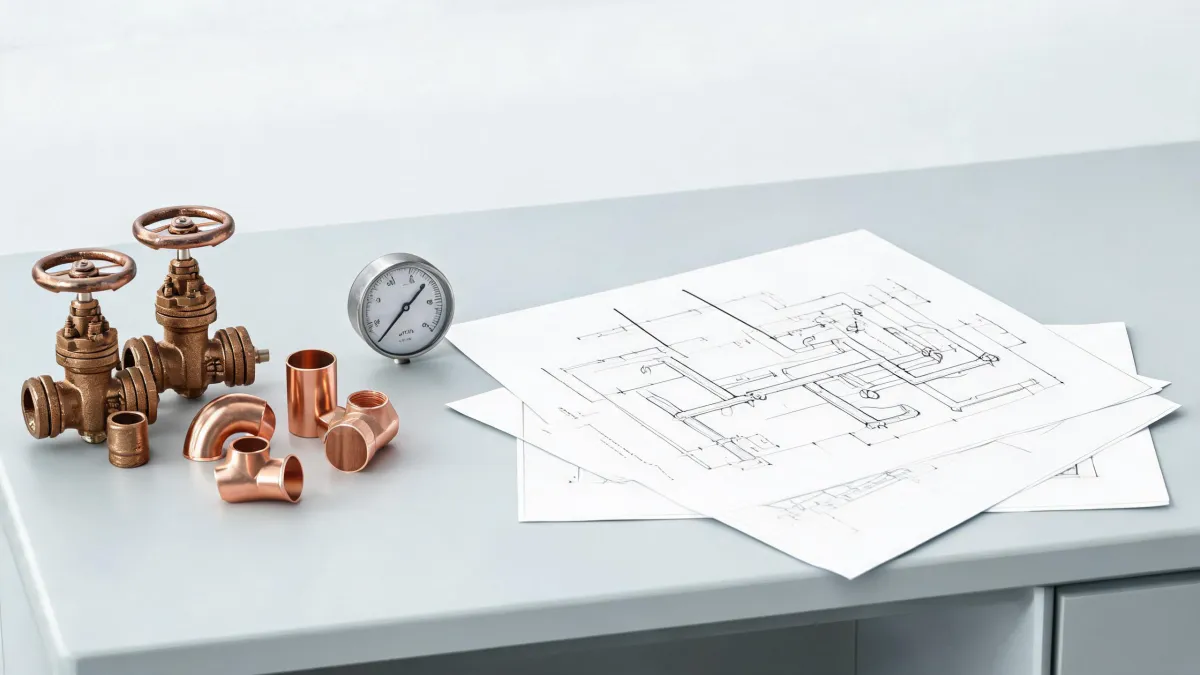
The 7:45 AM Lobby Leak
In February 2024, I was standing in our lobby when the maintenance lead texted me. A supply line was leaking in the lobby restroom. We had a client walkthrough at 9:00 AM.
I am the office administrator for an 85-person facilities services company. I manage MRO ordering—about $180,000 annually across 12 vendors. I report to both operations and finance. So when a leak threatens a client tour, I am the one who has to make the order happen.
The message was direct: he needed NIBCO PVC fittings and NIBCO press fittings. I thought, no problem. I had ordered parts before. I said I would get standard size. That was mistake number one.
What I Got Wrong About NIBCO PVC Fittings Dimensions
I said standard size. He heard whatever fits. Result: I ordered the wrong schedule fitting. The box arrived with a part that looked close but would not seal. We lost an hour driving to a local supply house.
When I took over purchasing in 2020, I treated MRO ordering as a checkbox. In our 2024 vendor consolidation project, I cut 19 vendors down to 12. That helped my invoice process. It did not fix my part knowledge.
Here is what I learned: NIBCO PVC fittings dimensions are not one universal thing. They follow standards by application. For Schedule 40 PVC pressure fittings, ASTM D2466 sets the socket dimensions. Schedule 80 follows ASTM D2467. DWV fittings follow ASTM D2665. Same nominal size on the label can mean different wall thickness, socket depth, and pressure rating.
Reference: ASTM D2466 covers Schedule 40 PVC fittings. ASTM D2467 covers Schedule 80. ASTM D2665 covers PVC DWV fittings. Always match the standard and schedule to the existing system.
I also learned that NIBCO press fittings are not just push and hope. The copper press-connect fittings we used are covered under ASME B16.51. For potable water, you want NSF/ANSI/CAN 61 and NSF/ANSI 372 for lead content. I am not 100% sure every local inspector reads it the same way, but those are the standards our supplier pointed to.
The Process Gap That Cost Us Twice
We did not have a formal fitting verification process. That cost us when the wrong schedule showed up. The third time we ordered the wrong quantity, I finally created a one-page intake form. Should have done it after the first time.
The form is simple. Photo of the old part. Outside diameter. Schedule. Connection type. Pressure rating. Standard. Then a second check: does this touch potable water? If yes, lead-free and NSF/ANSI 372 matter.
- Measure the outside diameter, not just the nominal size.
- Check Schedule 40 vs Schedule 80 vs DWV.
- Confirm pressure rating and temperature limit.
- For press fittings, confirm the tool and jaw are calibrated for that system.
The maintenance lead was patient with me. He said, you buy the parts, I trust you. I told him that was a bad idea until we had the form. Now he sends a photo and a part number. Ordering time went from about 45 minutes of back-and-forth to 15 minutes. (Should mention: the first month was slower while we built the habit.)
Tools, Chainsaws, and a Wire Wheel
The same week, maintenance asked for three other things: a GW72MCBMTS mechanics hand tool set for the service truck, a 211 chainsaw for storm cleanup at the north lot, and help on how to put wire wheel on angle grinder for rust removal on a valve flange.
Our old tool set was missing the 10mm and the ratchet had started slipping. The GW72MCBMTS mechanics hand tool set had the range they wanted, so I ordered it. The 211 chainsaw was for a satellite lot with downed branches after a windstorm. I am not a mechanic, but as the buyer I had to make sure the specs matched the job.
The angle grinder question was the one that made me laugh. I said, that is not my department. They heard, she will figure it out. Fair enough. The maintenance lead walked me through how to put wire wheel on angle grinder: unplug the grinder, check the arbor size—often 5/8-11 or 7/8 inch—match the wire wheel, use the proper flanges, keep the guard on, lock the spindle, tighten, and run it for 30 seconds before touching metal. I wrote it down because I was tired of ordering the wrong wheel.
That sounds basic. It was not basic to me. It showed me that the gap between a smooth repair and a mess is usually a spec detail.
The Two-Hour Decision
Back to the leak. I had two hours to decide before the rush cutoff. Normally I would get three quotes. There was no time. I went with our usual vendor based on trust alone. In hindsight, I should have checked stock before calling. But with the client tour at 9:00, I made the call with incomplete information.
The first order failed because of the schedule mismatch. The second order worked because the counter guy at the supply house said the sentence that fixed my process: NIBCO PVC fittings dimensions are standardized, but you have to match the schedule and pattern. I had been treating standard as universal. It is not.
We fixed the leak by 8:40 AM. The lobby was dry before the client arrived. Our VP mentioned the lobby looked good. He did not know about the failed order or the drive to the supply house. That is the point. The client never sees the fitting. They see the result.
Why Quality Perception Matters in Maintenance
In my opinion, the extra cost for the correct NIBCO parts was justified. It was maybe $40 more than the wrong box. The client tour was worth far more than $40. When a client walks into your lobby, they do not inspect the pipe behind the wall. They feel the room. Dry ceiling. Clean restroom. No maintenance cart leaking water across the tile. That is brand perception.
I used to think quality was a marketing word. Now I see it as an operations word. A cheap fitting that fails on a Friday afternoon makes your company look careless. A correct fitting from a known standard does not get noticed—which is exactly what you want.
I am not saying budget parts are always bad. For a non-critical drain line in a back lot, the math may be different. But for client-facing spaces or potable water, I rarely argue for the lowest line item. The savings usually show up somewhere else as a cost.
This worked for us, but our situation was specific: an 85-person facility with predictable MRO ordering and a maintenance lead who documents parts. Your mileage may vary if you are seasonal, spread across many sites, or relying on untrained staff to order.
What I Keep Now
After the leak, I built a binder. It has NIBCO PVC fitting dimension charts, press fitting standards, and a tool inventory. I add to it every time we order something new. The GW72MCBMTS mechanics hand tool set is logged. The 211 chainsaw has its own page for fuel and chain specs. The angle grinder wire wheel notes are there too, because next time I will not be guessing.
I also learned to say less. I said as soon as possible. They heard whenever convenient. Now I say the date and time. That one change cut a lot of confusion.
This was accurate as of early 2025. Standards, catalogs, and stock change. Verify current ASTM, ASME, and NSF references before you order. I am not 100% sure what the next update will be, but I know I will check it.
If you manage MRO buying for a facility, my advice is simple. Do not treat fittings as commodities. Do not treat tools as afterthoughts. The parts and tools you choose are part of how your company shows up. Even when no one sees them.