I'm a procurement manager at a 34-person construction and maintenance company. I've managed our materials budget—roughly $190,000 a year—for the past six years. I keep a running cost log in a shared spreadsheet. It's not pretty, but it's how I caught a pattern: most of our material budget overruns never come from the unit price. They come from assumptions. This is a story about one of those assumptions.
Everything I'd read about procurement says that when specs match, you take the lower price. In practice, I've learned that specs almost never really match until you verify them in writing. This is a story about NIBCO plumbing valves, a purchase order I almost sent, and the day the NIBCO fitting catalog made me stop.
The 24-Valve Job
Last September, a property manager asked us to replace 24 shutoff valves in a 1970s commercial building before winter. The old valves still worked, but only barely. One had already leaked and soaked a ceiling. The owner didn't want another emergency. The work had to happen in one weekend.
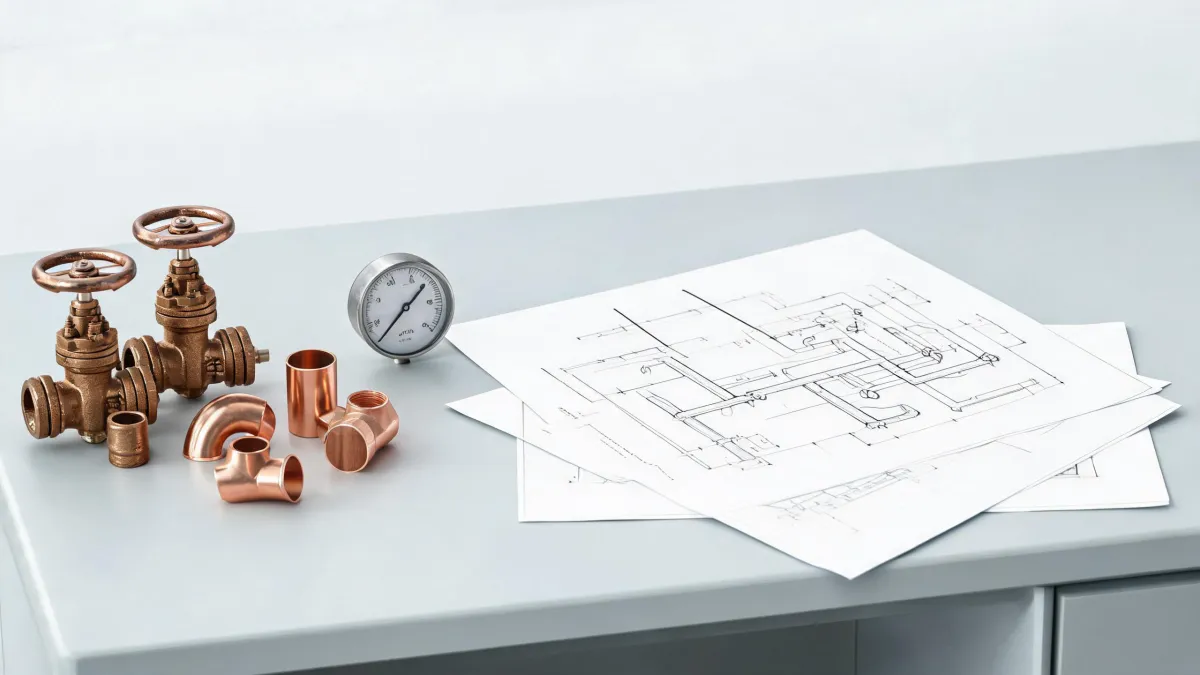
The spec called for 2-inch threaded bronze gate valves, lead-free, for potable water. Our usual supplier quoted NIBCO at $93 per valve. A newer vendor—one we met at a trade show—quoted $71 per valve for what they called “an equivalent.” For 24 valves, that was a $528 difference. Not enough to change the company, but enough to feel like a smart buy.
I started filling out the purchase order. The schedule made the decision feel urgent. The crew was already booked for the following Saturday. If I didn't approve something in 24 hours, we'd lose the weekend slot and probably the owner's patience.
The Missing Model Number
The cheap quote had all the right words on it: bronze, 2-inch, gate valve, lead-free. I was about to hit send when I realized something wasn't there. No manufacturer. No model number. I asked the vendor for the exact part number, and that's when the conversation got uncomfortable.
“What model is it?”
“It’s an equivalent. You won’t have any issues.”
I said “what model is it.” They heard “I need a reason to disqualify your quote.” What I meant was: I need something traceable in the job file before I spend money on a potable-water line.
To be fair, the vendor wasn't trying to run a scam. They were probably used to selling replacement valves by size and pressure rating, and most of the time that works. But this wasn't a toilet handle. This was a 2-inch line with code implications. Lead-free isn't a label you can take on faith. Under the Safe Drinking Water Act’s lead-free requirements, which took effect in 2014, plumbing products that contact drinking water have to meet a specific weighted average lead limit (Source: EPA, epa.gov). I needed documentation, not reassurance.
The next email came back: “It’s equivalent to NIBCO. Trust me.”
I don't do “trust me” on a 2-inch potable-water line.
What the Catalog Showed Me
I opened NIBCO’s current catalog data on nibco.com and pulled up the valve our regular supplier had quoted. The page listed the exact product series, end connection, dimensions, pressure rating, and lead-free certifications. It gave me a document I could put in the project file. The other quote only gave me an email address.
Maybe the cheaper valve was perfectly compliant. Maybe it wasn’t. I couldn’t tell, and the inspector on that job was not going to accept “the vendor said so.”
The NIBCO fitting catalog also helped us confirm that the physical dimensions matched the old valves in the building. That matters more than people think. When you replace 24 valves in an occupied building, you don't want to discover on Saturday morning that the replacement is 3/4 of an inch longer than the old one. The catalog drawing is your chance to catch that before you order.
This is not me saying every valve on earth must be NIBCO. It's me saying every valve needs to be identified well enough that someone else can verify it. If a supplier can't match their own part to a published spec sheet, the price is just a number.
The Real Total Cost
If the cheaper valve had been exactly what we needed, we would have saved $528 in material. But if one valve was wrong, we would have paid more than that in labor, return freight, inspection delays, and frustration. A weekend crew on overtime is not cheap. A callback after the building opens is worse.
We approved the NIBCO order. The material difference was $528. The added certainty was worth it. I don't want to pretend that cost doesn't matter—$528 is real money. It just wasn't the deciding factor after I looked at what was hidden behind it.
That's when I started calculating total cost instead of just price. Unit price matters. It's just not the first thing I check anymore.
The Rule I Use Now
It took me six years and a few supplier-caused do-overs to understand this fully: a quote is not a spec sheet. A price is an offer. A specification is a promise, and the only way to compare promises is to compare spec sheets.
Now every PO we send has the manufacturer’s part number, a link to the published data sheet, and a delivery date that someone is willing to put in writing. If the vendor can't provide those basic details, the conversation ends. This isn't a punishment. It saves them time, too.
The same logic applies outside of NIBCO products. If someone asks how to measure a hydraulic cylinder for replacement, the answer starts the same way: don't order by model number alone. Check mounting style, rod diameter, stroke, pin-to-pin length, and port sizes. If a mini chainsaw price looks too good to be true, ask what bar and chain it uses and whether you can actually buy spares. If a 30-piece carbide-tipped router bit set costs less than one decent bit, find out the shank size and the grinding quality before you celebrate.
Price is a clue. It is not a specification. That was the lesson from one 24-valve job, and it's why I still read the NIBCO fitting catalog before I approve replacement valve orders.