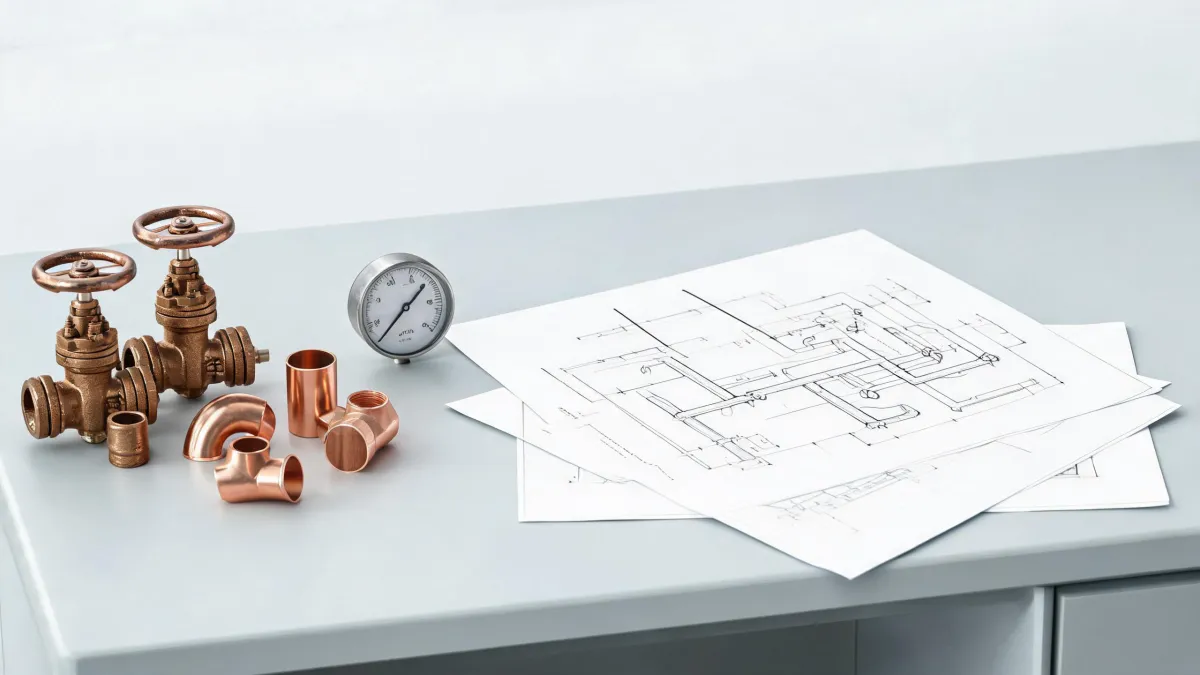
When a valve fails and the job has to get done yesterday, you don't have time for guesswork. I've been on the supply side of the plumbing industry since 2016, handling over 400 rush orders for replacement valves—including same-day turnarounds for contractors with shutdown windows measured in hours. This is the checklist I mentally run through on those calls. It's not the textbook version. It's the one that gets you a working valve without a callback.
Here's a mindset that helps: picking a valve is a lot like picking a router bit. People ask me what are the uses of different router bit shapes? all the time. A straight bit cuts a flat-bottom groove. A dovetail bit makes interlocking joints. A round-over bit softens an edge. Each one has a specific job. Same with valves. A ball valve is for on/off control. A gate valve is for isolation with minimal restriction. A globe valve is for throttling. Grab the wrong shape and the whole job goes sideways.
So here are the five steps I use to spec a NIBCO ball valve for an urgent replacement. Plus a few mistakes I see contractors make at least once.
Step 1: Nail Down the Connection Type
Before anything else, you need to know how the valve connects to the pipe. The three options are threaded (FPT or MPT), solder (sweat), and press (ProPress). The NIBCO NJ998X is a textbook example of the threaded type: a 1/2-inch FPT brass ball valve with standard port. It's one of the most common NIBCO valves I spec for water line replacements, especially when the old valve is seized and the stub-out is threaded. FPT means the valve has female threads on both ends, so it connects to male-threaded nipples.
If you don't know the size, measure the pipe OD and match it. A 1/2-inch valve takes 1/2-inch pipe. Sounds obvious, but I can't count the calls from someone who ordered 3/4-inch and didn't notice until the fitting wouldn't thread on.
Step 2: Know the Media (and the Codes That Go With It)
What's flowing through the line—potable water, natural gas, compressed air, chemicals? This determines everything from the valve material to the certification marks it needs to carry.
Here's where I draw my own line: I'm not a gas engineer, so I can't speak to every local code requirement. What I can tell you from a supply perspective is that any NIBCO gas ball valve comes with specific approvals—normally CSA or AGA listing for natural gas and LP gas. It's not enough that the valve looks heavy-duty. Gas service requires the right listing mark on the body.
The NIBCO 94ALF is another valve that comes up often. That's a lead-free bronze ball valve, commonly specified for potable water. The LF suffix indicates it meets lead-free requirements. This gets into water quality regulation territory, which is beyond my exact expertise—so I always recommend checking the NSF and ANSI listings for the specific application.
Step 3: Match the Material to the Application
NIBCO ball valves are made from brass, bronze, or stainless steel. For most residential and light commercial work, brass handles water and air without issues. Bronze is a step up for corrosive environments. Stainless is for aggressive media where you'd get pitting otherwise.
Here's the misconception I run into constantly: All brass valves are the same was true 20 years ago. It isn't anymore. Lead-free requirements changed the alloy chemistry. A modern lead-free brass valve uses a different material (like C693), not just a coating or a surface treatment. So check the body stamp or tag—don't assume.
Step 4: Pick the Right Tools for Installation
For threaded valves, you need a proper sealant and a wrench that fits the hex without rounding it. A 24mm ratcheting wrench is a favorite of mine for 3/4-inch and 1-inch NIBCO ball valves. It grips the hex closely without the bite marks a pipe wrench leaves. I also keep one in my service truck because certain NIBCO repair kits call for it when you're rebuilding the stem assembly.
If you're going the press route, you'll need the right jaws for your press tool, and the tool itself is a significant investment. For a contractor who only does a handful of fittings a year, a threaded valve and a good wrench might make more sense financially. Can't argue with the math.
Step 5: Verify Certifications and Traceability Before Hanging It
This is the step everyone skips when they're in a hurry. I get it—the client is hovering and the clock is running. But I've seen inspections fail because the valve lacked the visible listing mark.
Check for:
- Lead-free marking (LF or NSF 61) for potable water lines
- CSA or AGA approval for gas service
- Pressure rating on the body—typically 600 WOG for NIBCO brass ball valves
- Date code and lot number for warranty traceability
I once had a contractor bring back a gas-rated ball valve he bought from a wholesaler online. It looked perfect, but there was no CSA mark, no date code, nothing. It wasn't from an authorized NIBCO distributor, so there was no way to verify it was genuine. Buying from an authorized distributor costs a few dollars more, but it gives you traceability. When you're rushing, you don't want to gamble on mystery inventory—(surprise, surprise) that gamble has a way of failing the inspection.
One more thing about time: the value of guaranteed delivery isn't just the speed, it's the certainty. For a shutdown job, knowing the valve arrives when promised is worth more than saving a few bucks on a back-ordered alternative.
Common Mistakes I See Out There
Mistake #1: Wrong sealant for gas lines
Pipe dope and Teflon tape are not interchangeable. Use a sealant rated for natural gas. Some water-rated dope degrades in gas service—that's not a risk worth taking.
Mistake #2: Cross-threading brass valves
Brass is soft. When connecting to steel pipe, start the threads by hand and feel for clean engagement before wrenching. A cross-threaded valve will leak eventually—usually halfway through your next task.
Mistake #3: Forgetting handle clearance
A ball valve needs room for the handle to swing. I've seen valves installed flush against a stud or another pipe, handle hitting before it's fully open. That's a built-in flow restriction.
Mistake #4: Skipping the pressure test
Honestly, I've never understood why guys skip this one. I guess it's time pressure, but a 10-minute air or water test can prevent a flooded ceiling and a call at midnight. Do the test.
If you're stuck between a standard port and a full port ball valve, here's my take: for the main shutoff, go full port. The extra flow capacity is worth the cost difference. I went back and forth on this during a commercial job last year—standard port would've saved money, but the pressure drop across the valve mattered for the client's system. Full port was the right call, and nobody regrets having enough flow.
And if you're genuinely not sure which NIBCO valve fits the job, grab the current catalog or call a supply house that knows the product line. That's not me pushing you away—it's me telling you that a quick conversation with someone who does this all day beats a misinformed guess.