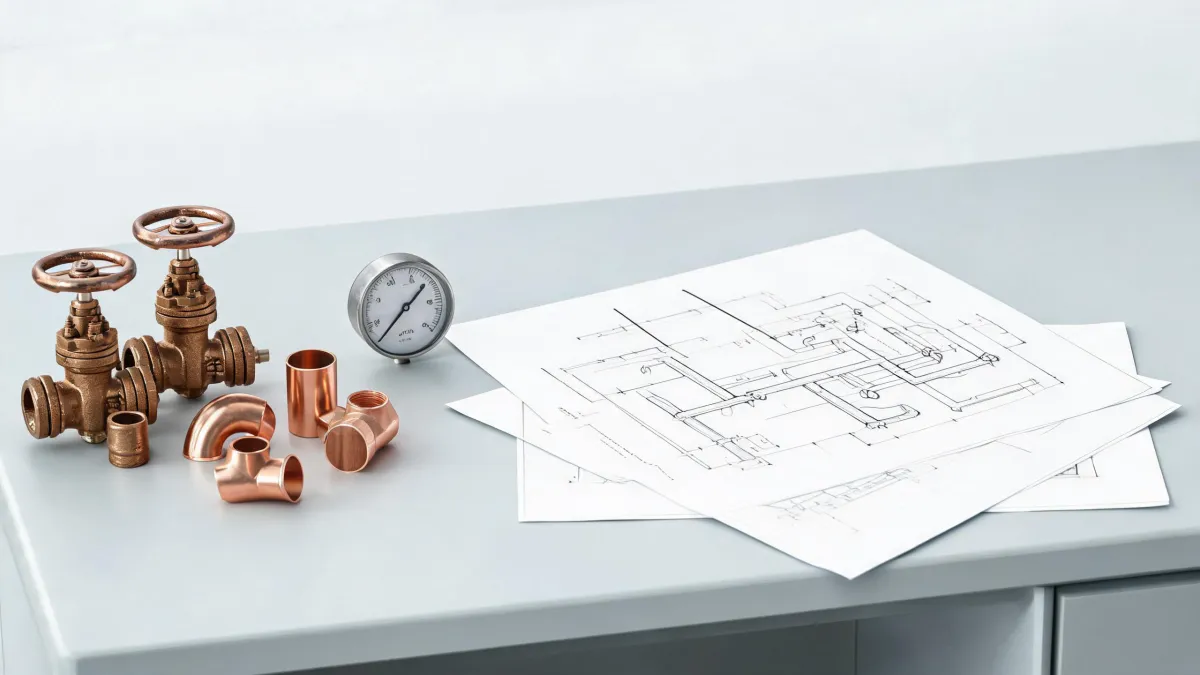
If you've ever opened a crate of NIBCO gate valves and felt your stomach drop when the stem height doesn't match the handwheel operators you're connecting, or bought NIBCO ball valve handles that won't seat on the stems they're supposed to fit, you already know: the part can look perfect in the box and still be wrong.
This isn't a story about a bad supplier or a defective product. Both were fine. It's a story about how I confused a brand name with a fully specified part.
I handle material orders for a mechanical contractor. Nine years in, 23 documented mistakes, roughly $47,000 worth of 'experience.' The one I'm about to describe was the most expensive per square inch of bronze I've ever paid for.
The Surface Problem: The Parts Looked Right
We ordered 64 NIBCO gate valves for a chilled water loop retrofit. The engineer's schedule said NIBCO by name. The distributor had them in stock. The P.O. went out in under an hour.
The takeoff had been done in 2019, but the project got delayed. By the time we ordered, the product line had moved on. Nobody thought to check because 'NIBCO gate valves' was written on the schedule as if it were a part number. Then the shop called: the stems were a quarter-inch taller than the old valves we were replacing. The handwheel operators we had already prepped wouldn't align. Same valve size, same end connections, same pressure class. Just not the same series.
That same week, for another job, I ordered a box of replacement NIBCO ball valve handles. They looked identical to the ones in place. But the stem interface had changed. The new handles were splined; the old valve stems weren't. Two projects. Two 'same part' failures. One root cause.
The Deeper Cause: I Assumed 'NIBCO' Was the Spec
Here's the thing I missed: NIBCO gate valves is not a complete specification. It's a product family. Inside that family, series numbers, stem configurations, and handle patterns change over time. The same is true for NIBCO ball valve handles. Just because the branding looks the same doesn't mean the interface stayed the same.
I made a classic communication mistake. I told the counter guy, 'We need the NIBCO gate valves we got last time.' He heard, 'Same series as last time.' We both meant well. We both were wrong.
The surprise wasn't that the distributor shipped a bad product. It was that the series number I'd pulled from a 2019 takeoff had been superseded. NIBCO had updated the valve line, and the old handwheel operators no longer fit. The distributor's system didn't flag the mismatch. Why would it? I ordered a part number, not a handshake.
The same week, I ordered replacement handles for a separate repipe job. I didn't check the stem interface because the part number had been correct for the last three years. The box said 'handle kit.' The box didn't say 'for the new stem design only.' Again, the issue wasn't the manufacturer. It was my assumption that a product name is a complete description.
Every valve in a NIBCO catalog has a series number for a reason. That number maps to material, pressure class, stem length, and handle interface. The design and compliance standards—ASME B16.34, MSS SP-80, and NSF/ANSI 61—are all public. But no one is going to read them for you if you order by brand name.
I still kick myself for that 20-minute phone call. If I'd verified the series and stem height before the P.O. went out, we'd have avoided the whole mess. But the project manager was standing in my doorway, and the trucking cutoff was in two hours. Time pressure made me stupid.
The Cost: Cheap Quotes Get Expensive Fast
Let me show you what 'I saved money on the order' actually meant.
- Restocking fee and return freight: $312
- Expedited freight for the correct series: $440
- Shop labor for test-fitting and re-labeling: $1,280
- Overtime plus schedule penalty: $1,955
That's $3,987 in extra costs—before we talk about the fact that the original valve order was only $220 cheaper than buying the right series from the supply house that knew the product line.
The reorder itself took six days because the correct series had to come from a different warehouse. That mattered because the client had a shutdown window of ten days. We used seven of them fixing my mistake. The last three days were a blur of overtime and bad coffee.
That's the part that never shows up on a vendor quote: the cost of being wrong. The budget line sees a $220 savings; the P&L sees $3,987 in overtime, freight, and restocking. I'm not saying every low quote is a trap. But the cheapest option only works if everything else about the order is already correct.
I'm not an anti-budget purist. I've used budget suppliers when the spec was simple and the stakes were low. The trouble starts when you treat 'quick and cheap' as a substitute for 'verified and correct.' That's the difference between a purchase order and a procurement policy.
The Fix: Checklists, Specs, and Tools That Do Their Job
I don't have a magic system. I have a checklist on the wall by the phone. Three questions:
- Does the series number on the current submittal match the series on the original takeoff?
- Are stem dimensions, handle pattern, and pressure rating identical across every line item?
- Did we get written confirmation from the distributor—not a rushed phone confirmation?
The checklist has caught 11 potential mismatches in the past 18 months. That's 11 reorders we didn't have to make, and about $8,000 in labor and freight we didn't spend. Boring, but effective.
And yes, tools matter too—not the fanciest ones, but the right ones. A combination ratcheting wrench earns its place in the bag when you're torquing valve packing nuts in a pump room where you can't swing a standard wrench. A forged steel eye & eye turnbuckle is the difference between a pipe support that holds its position and one that sags after the system heats up.
And if you've ever asked, 'what are hose clamp pliers?'—they're the tool that compresses a clamp's ears evenly without slipping off and chewing up the threads. They have angled tips with small notches that grip the ears of pinch-style clamps. You squeeze the handle, the clamp opens evenly, and you don't destroy the clamp in the process. A regular pair of pliers can do that too. They can also slip. Ask me how I know.
None of these tools are glamorous. Neither is reading a spec sheet. But both are cheaper than the alternative.
Bottom Line
If you're ordering NIBCO gate valves or replacing NIBCO ball valve handles, write down the complete series number. Check the stem and handle interface. Get the return policy in writing before you commit. And when you compare quotes, remember that expedited freight, restocking fees, your own labor, and your customer's patience are all part of the price.
You can get lucky. But lucky isn't a process. The cost of being wrong is always higher than the cost of checking. The right part isn't the one that looks right in the box. It's the one that works when the system is pressurized. That distinction has cost me $3,987 so far. Hopefully, this article costs you a lot less.